From Symptom to Solution: A Structured Problem-Solving Framework for Engineers

This post was auto-generated from our daily engineering knowledge sharing session and reviewed by our team before publishing. At ArcFusion, we believe in learning out loud — sharing what we build, how we build it, and what we learn along the way.
Presenter: Varatcha Vanarungruedee
Engineers are natural fixers. When a bug surfaces or a client complains, the instinct is to dive in and start patching things. But without a structured approach, you end up in an endless loop — fixing one thing only to have another pop up — chasing problems rather than solving them. In today's knowledge sharing session, we walked through a practical framework for cutting through client noise, diagnosing real problems, and focusing effort where it matters most.
The Real Problem Behind the Complaint
Clients rarely describe problems precisely. They say things like:
- "This isn't working."
- "The UI looks off."
- "It doesn't feel easy to use."
These are symptoms, not root causes. Your first job is to bridge the gap between what the client perceives and what's actually happening technically. That requires active communication before any code is written or changed.
This is Step 1: Define the actual problem. Ask questions. Dig deeper. Is it a data issue? A third-party API? A rendering bug specific to one device? Until the real problem is defined, all subsequent work is guesswork.
The 5-Step Problem-Solving Framework
Once you understand the real problem, a structured 5-step approach helps you move from chaos to clarity:
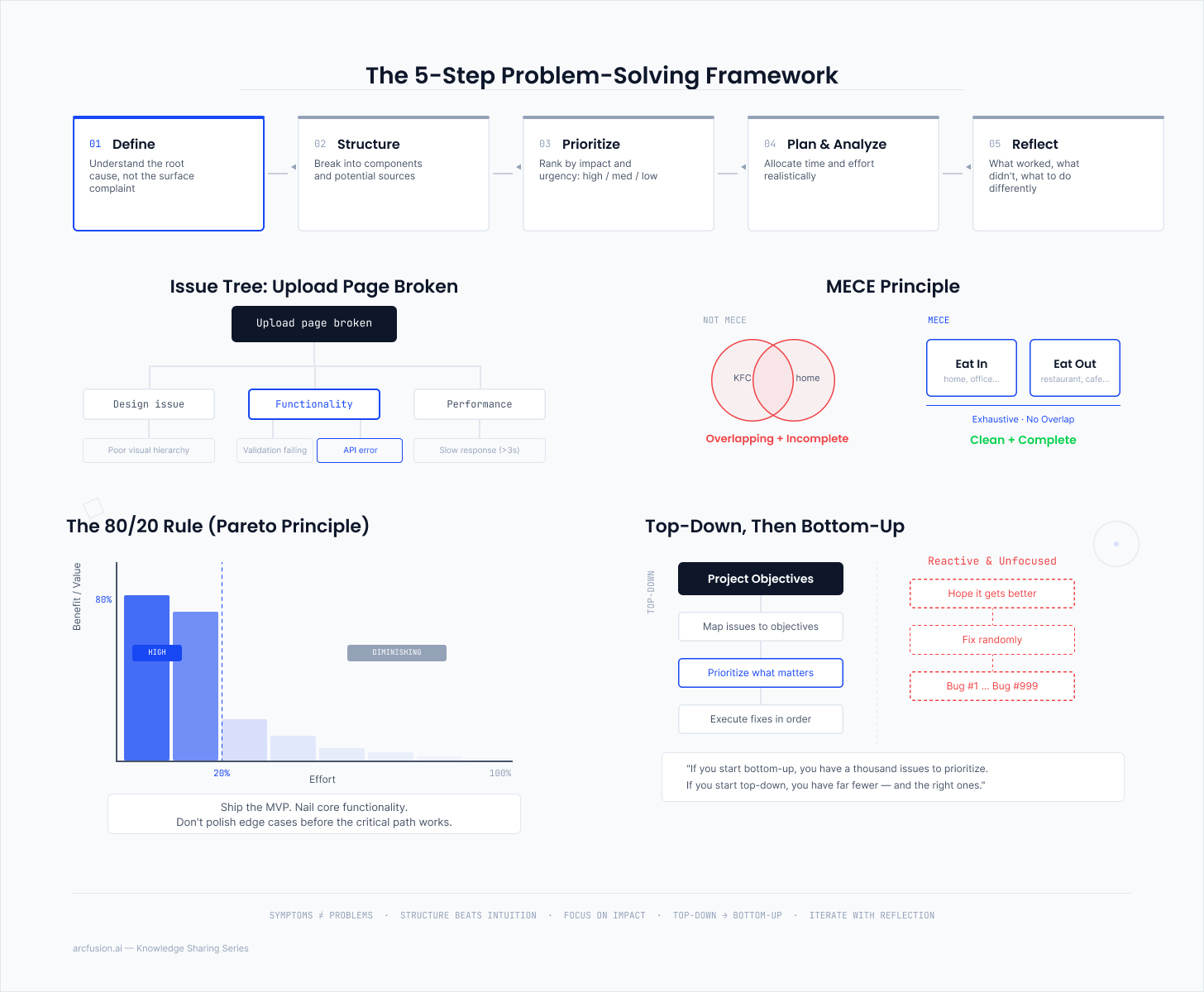
- Define the problem — Understand the root cause, not just the surface complaint
- Structure the problem — Break it into components and potential sources
- Prioritize — Rank issues by impact and urgency (high / medium / low)
- Plan and analyze — Allocate time and effort realistically; don't spend a disproportionate time on a low-impact fix
- Analyze results and learnings — Reflect after resolution: what worked, what didn't, what you'd do differently
Repeated practice of this loop builds speed and instinct. It transforms reactive fire-fighting into proactive, structured delivery.
Issue Trees: Structuring Your Thinking
Once the problem is defined, you need to break it apart systematically. This is where the Issue Tree methodology comes in. There are two flavors:
1. Issue Tree (What / How)
This approach decomposes a problem into its components. Start with the symptom and ask: What are the causes? How does each component contribute?
For example, if the client says "the upload page isn't working":
Upload page broken
├── Design issue
│ └── Poor visual hierarchy or layout
├── Functionality issue
│ ├── File size validation failing
│ └── API call returning error
└── Performance issue
└── Slow response time (>3s loading)
2. Hypothesis-Driven Tree (Why / Reasoning)
This approach starts with a proposed solution and builds reasoning to support or refute it. It's useful when you already have a strong intuition and need to validate it quickly.
Hypothesis: Users should spend less on discretionary items
├── Buying generic alternatives saves ~20–30%
│ └── e.g., tissue paper, cleaning supplies
├── Entertainment substitution reduces cost
│ └── PDFs over books, home streaming vs. cinema
└── Reducing dining out saves significantly
└── Meal prep at home reduces spend by ~40%
The MECE Principle: Making Your Breakdown Airtight
Any time you decompose a problem, you risk creating overlapping or incomplete categories. The MECE framework — Mutually Exclusive, Collectively Exhaustive — guards against this.
- Mutually Exclusive: No overlap between categories. Each issue or cause belongs in only one bucket.
- Collectively Exhaustive: All possibilities are covered. Nothing falls through the cracks.
A bad breakdown (not MECE):
Where do you want to eat? → KFC, McDonald's, at home, office, park...
A MECE breakdown:
Eat in / Eat out — two exhaustive, non-overlapping options.
Three Ways to Create MECE Breakdowns
- Equation method — Use a mathematical identity.
- Example: Profit = Revenue − Cost
- Now you have exactly two non-overlapping drivers to analyze.
- Process / Chain method — Follow a sequential flow where stages don't overlap.
- Example (customer journey): Awareness → Consideration → Purchase → Usage → Loyalty
- Opposite pairs — Use binary splits.
- Example: Male / Female, Earn more / Spend less, Internal / External
Practical Exercise: "How Do I Save More Money Each Month?"
We ran a live group exercise to practice MECE issue tree construction. The problem statement: How do I increase the amount I save each month?
Here's one strong breakdown from the team:
Increase monthly savings
├── Earn more
│ ├── Labor income
│ │ ├── Work more hours
│ │ └── Get paid more (promotion, new role)
│ └── Asset income
│ ├── Investments (stocks, funds)
│ └── Side projects / freelance
└── Spend less
├── Discretionary (wants)
│ ├── Dining out → cook at home
│ ├── Entertainment → streaming vs. cinema
│ └── Shopping → reduce impulse purchases
└── Fixed (needs)
├── Housing → refinance / renegotiate rent
├── Utilities → reduce usage (electricity, data plan)
└── Loans → refinance for lower interest
Why this works: The top-level split (earn more / spend less) is MECE — every dollar improvement falls into one of these two buckets, and there's zero overlap. Each subsequent level stays within its branch.
Prioritization: The 80/20 Rule in Practice
After structuring all issues, engineers often feel overwhelmed — there are ten things to fix, and they all seem urgent. The 80/20 rule (Pareto Principle) reframes this.
80% of the project's value comes from 20% of the effort.
The key insight is that the effort-to-benefit curve is non-linear. The first 20% of focused effort delivers the bulk of the results. Beyond that point, returns diminish sharply. Trying to reach 100% perfection often takes exponentially more time — time that may never be recovered.
Benefit
│
│ ████
│ ████████
│ ████████████
│ ████████████████
│ ████████████████████▓▓▒░░
└──────────────────────────────── Effort
↑ 20% ↑ 100%
80% of value marginal gains
Practical implication: Ship the MVP. Nail the core functionality. Don't polish edge cases before the critical path is working.
Top-Down Before Bottom-Up
The most common mistake in engineering is starting bottom-up — finding a bug and fixing it immediately, then finding another, then another. It feels productive, but it's reactive and unfocused.
A better approach:
- Start top-down. What are the project's primary objectives? What did you promise to the client or PM?
- Map issues to those objectives. Does this bug affect the critical deliverable, or is it cosmetic?
- Prioritize what matters. Fix things that block the main goal first.
- Then go bottom-up — execute the fixes one by one, in priority order.
This doesn't mean ignoring small issues forever. It means not letting them hijack your attention before you've secured the big wins.
"If you start bottom-up, you have a thousand issues to prioritize. If you start top-down, you have far fewer — and the right ones."
Key Takeaways
- Symptoms ≠ Problems. Always invest time in defining the real issue before jumping to solutions.
- Structure beats intuition. Use issue trees and MECE to make your thinking visible, testable, and shareable with your team.
- Prioritization is a skill. Not everything needs to be fixed. Focus on impact relative to project objectives.
- Start top-down, execute bottom-up. Understand the big picture first, then drill into execution.
- Iterate with reflection. After each problem-solving cycle, ask: what did I learn? What would I do differently?
These habits compound over time. The more consistently you apply structured problem-solving, the faster and more confident you'll become — even in ambiguous, high-pressure situations.
We are always hiring, if you're interested, come join us at https://www.arcfusion.ai/